
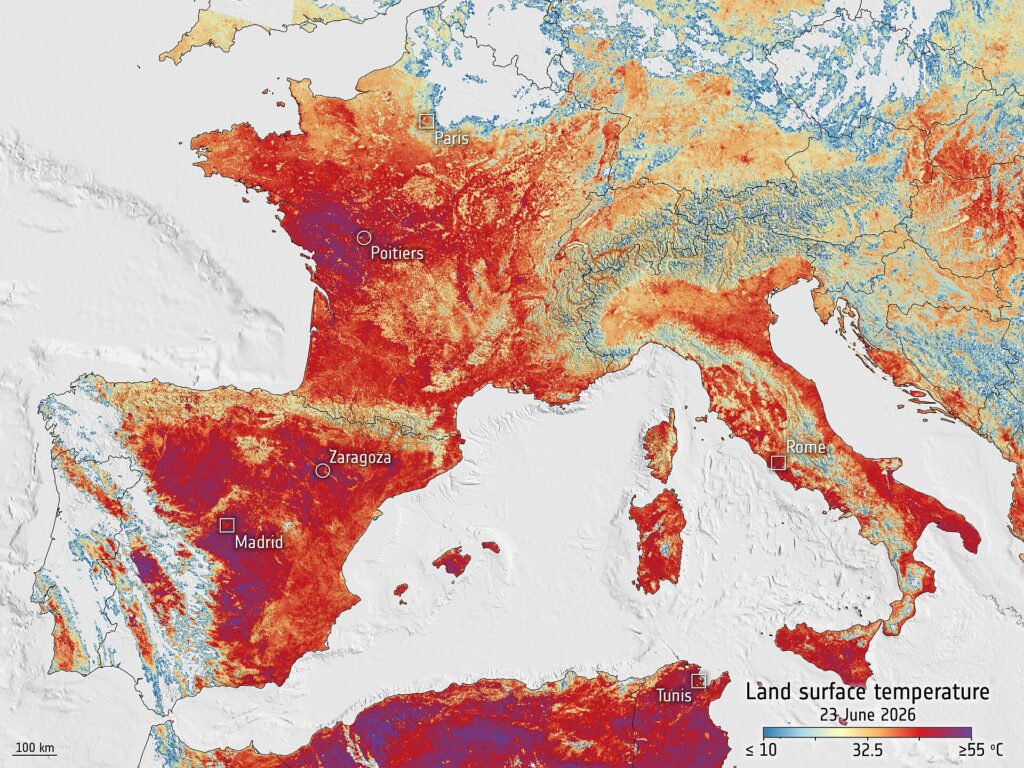
PARIS — France has experienced record-breaking 52 days of heatwave so far this year, up from 33 in 2022 and 22 in the deadly summer of 2003.
That’s an increase of 11 days from 2003 to 2022, and 19 days from 2022 to 2026.
It’s the highest number of heatwave days since Météo-France began recording them in 1947 — and the increases themselves, rather than the totals, are notable; this has been the warmest summer on record, with 136 of France’s weather stations on the mainland and Corsica setting new highs.
Authorities are reporting more than 7,300 excess deaths so far this year, as of mid-August, with numbers climbing.
By comparison, the 2003 heatwave in France killed around 15,000 people — the most since records began.
That has contributed to the creation of the nationwide heatwave response system, hospital surges, and heat-alert registry that’s helped save thousands of lives this year and in subsequent years following 2003; the mortality rate is down by around 90%.
This year’s figures are already set to reach half of 2003’s total, suggesting that while it’s not failing, the response system is being severely tested.
France saw its hottest day on June 23rd, with a national average of 29.8°C and 40.3°C in Paris.
The Eiffel Tower was temporarily closed to visitors due to the heat, and large parts of the country saw widespread power outages as air conditioning reached peak usage.
Hospitals activated emergency “plan blanc” surge protocols, and authorities opened cooling centers and issued nationwide “Orsec” heat alerts in response.
The heatwave extended to the UK, Germany, Spain, and Portugal, with scientists noting that Ireland was also affected, as of late May.
Much of the discussion this summer has revolved around a theoretical formation of El Niño in the Pacific Ocean, a natural climate phenomenon characterized by a build-up of warm surface water in the central and eastern Pacific, which occurs when trade winds pushing warm water towards Asia fail to intensify.
While the timing of it is unfortunate for proponents of the theory, the World Meteorological Organization assigned an 80% chance to it forming as of June, and the National Oceanic and Atmospheric Administration (NOAA) finally raised the odds to over 90% in August — suggesting El Niño, at least, remained a largely hypothetical force as of August. An effect cannot be used to explain a cause that has yet to materialize.
Some climate scientists have pointed to a high-pressure blocking system over the Arctic — weakening the jet stream and contributing to heat-retention over Europe — as the summer’s main force, and argued that El Niño, while present, is a “distraction” from the more immediate effects of anthropogenic global warming.
The WMO has assigned a 90% chance to El Niño persisting through November, and NOAA has warned that, if it does develop, temperatures in the Pacific would surpass the 2C threshold and set a new surface temperature record for the region.
The current El Niño has not been officially designated a “super El Niño” — but some scientists suspect it to rival the 1876-78 event, in terms of surface warmth.
El Niño is separately responsible for millions of deaths around the world, notably disrupting regional monsoons in the 19th century, which led to famine and drought in India and China.
A similar catastrophe is not expected to occur as a direct result of the event.
Little of this reads like a comprehensive summary of a purely meteorological event, however, as it is not only a health and environmental concern, but a political one at the highest levels of government.
Despite the catastrophe unfolding, it remains to be seen if the momentum behind climate change mitigation will gain ground at the G20 later this year, with the leaders’ meeting to be held in December at Trump National Doral in Miami.
The stated goals of the American presidency emphasize economic growth, energy security, and innovation, with climate change not being explicitly among them — and the timing of this summer’s heatwave, and its associated mortality rate, may have little impact on the discussions to occur in Miami.
US officials have already opposed climate-focused language to be introduced at the ministerial level by the G20; Secretary of State Marco Rubio notably boycotted the foreign ministers’ meeting in Johannesburg, criticizing it for advancing “anti-American” themes of solidarity, equality, and sustainability.
It is yet to be seen if that opposition will be revised, ahead of the 2026 meeting in the US, as the toll of the summer approaches halfway to 2003’s figures.
What isn’t in question is the trend line behind it: 22 days, then 33, then 52 — a pattern that’s steepening every summer it repeats, whether or not the politics keep pace with it.