
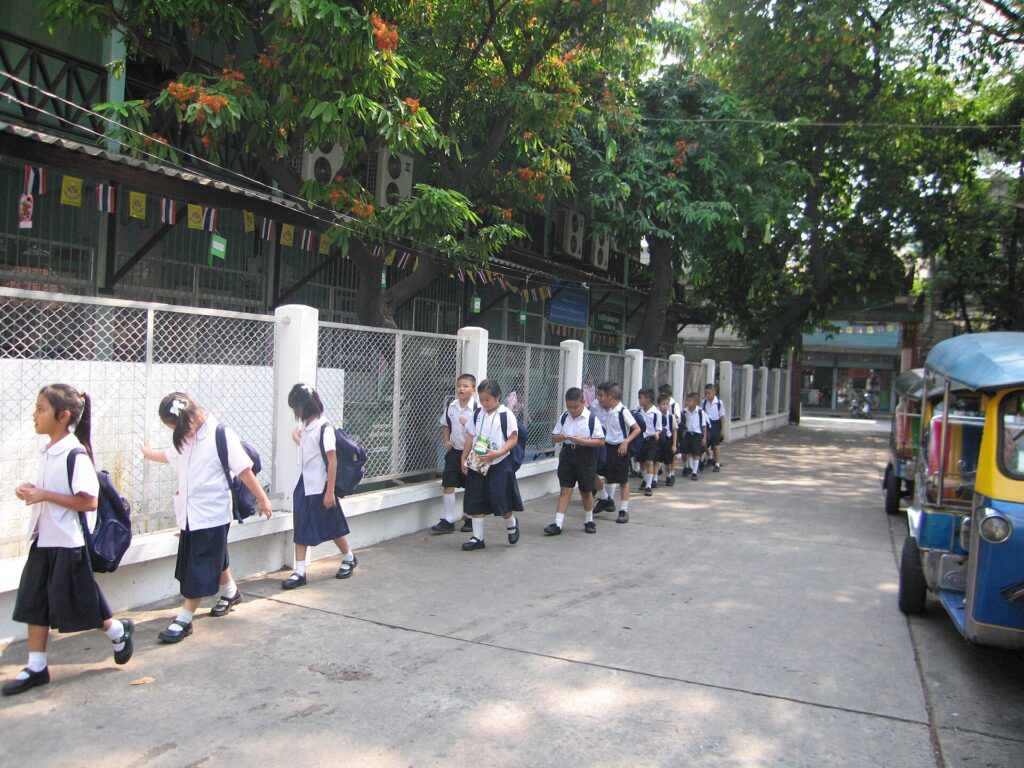
The dropout crisis is currently one of the utmost issues in Thailand. In 2023, a national data-linkage exercise that cross-referenced the records of civil registration shed light on 1.02 million children aged 3-18 out of ten million children across 30,000 schools that were absent from the education system.
Even worse, the burden is unevenly distributed, dropping heavily on those in the mountainous border provinces of the north and west and in the dense periphery around Bangkok. From grade 6 to grade 9, post-compulsory teenagers living in those areas leave to work. Poverty, family instability, and rigid, academically narrow schooling are the dominant drivers. In response, the government launched the Thailand Zero Dropout initiative in 2024, aiming to reintegrate one million learners by 2027.
Funding for this effort is substantial; and while Thailand’s educational system is large enough to support a meaningful program, its response to this crisis will be constrained by several limitations. There is no central authority over the school system; instead, there are six separate ministers each responsible for a portion of the overall education budget. As a result, the Equitable Education Fund (EEF), created in 2018 as an independent “demand side” financing organization to provide resources directly to individual families, is currently the primary financing source for this system. The EEF uses data from the Information System for Equitable Education (iSEE) to track the attendance of students receiving CCTs and link student attendance to geographic locations.
In addition, the system relies primarily on conditional cash transfers (CCTs). These programs use funds received from the government to make monthly payments of approximately $90 to families who meet certain conditions (such as attending school at least 85% of the time during a given semester) to encourage their children to attend school. There are currently just over 1.3 million students participating in these programs and they were selected based on a combination of factors including but not limited to home visits made by more than 400,000 teachers.
Although the government has recently begun to push more responsibility for coordinating the effort downward into provinces with its Area-Based Education Initiative (which began in 2019), most of the work continues to take place at the national level. While there is a new policy called Thailand Zero Dropout (TZD) aimed at reducing dropout rates and providing alternative learning opportunities for students who drop out of traditional schooling, the TZD policy was approved by the cabinet in May of 2024 and it does not yet formally establish a clear plan or timeline for addressing the problem of dropout. As seen, scale and funding have not translated into solutions, and specifically, it is in the system’s structure – on top of its resources – that its limitations become more clear.